
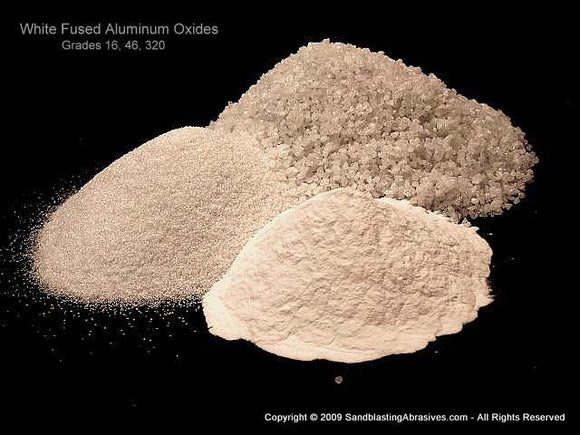


Fine White Fused Aluminum Oxides 220 - F1200 Grit
High-purity, sharp-cutting abrasive for microblasting, lapping and precision surface finishing
Fine white fused aluminum oxide—also called white fused alumina, white A/O, WFA or aluminum oxide microgrit—is a high-purity abrasive used where controlled cutting action, low iron content and a clean finished surface are important.
The grain is produced by fusing calcined alumina in an electric arc furnace, followed by crushing and precision grading. Its angular particles cut efficiently and fracture during use to expose fresh cutting edges.
Unlike coarse blasting abrasive, the 220 through F1200 range is intended for fine surface refinement, microblasting, controlled etching, lapping, deburring and abrasive-product manufacturing.
Product Highlights
- High-purity white fused aluminum oxide
- Sharp, angular grain structure
- Low iron content
- Clean white color
- Controlled fine-particle distribution
- Fast cutting with self-renewing edges
- Suitable for wet or dry processing
- Available in macrogrit and FEPA microgrit sizes
- Useful for microblasting, lapping, etching and fine finishing
- Nonflammable
- Insoluble in water
- Chemically stable under normal conditions
- Industrial, commercial and hobbyist quantities available by grit
Why Choose Fine White Aluminum Oxide?
Fine white fused aluminum oxide is useful when a coarse abrasive would create too much surface profile, remove too much material or leave a finish that is too rough.
Its combination of high purity, angular grain and controlled sizing makes it suitable for:
- Producing fine matte finishes
- Removing very light oxidation
- Cleaning delicate metal components
- Precision deburring
- Controlled glass etching
- Surface preparation before coating, plating or bonding
- Lapping flat or fitted surfaces
- Producing abrasive compounds and coated products
- Refining surfaces between coarse grinding and final polishing
White fused alumina generally breaks down more readily than brown fused alumina. This friability continually exposes fresh cutting edges, although it may also give white aluminum oxide a shorter reuse life in high-impact blasting systems.
Grit Selection Guide
| Grit | Relative finish | Common starting applications |
|---|---|---|
| 220 | Very fine blasting profile | Fine cabinet blasting, glass etching, light deburring and coating preparation |
| F240 | Fine cutting | Microblasting, controlled etching, lapping and abrasive manufacturing |
| F280 | Fine refinement | Precision deburring, fine matte finishing and surface correction |
| F320 | Smoother refinement | Metal finishing, ceramic finishing and lapping |
| F360 | Fine surface conditioning | Pre-polishing, controlled lapping and fine abrasive products |
| F400 | Very fine finish | Jewelry finishing, precision components, glass and ceramic work |
| F500 | Pre-polishing range | Fine lapping, delicate components and surface refinement |
| F600 | Extra-fine finish | Precision lapping, smooth satin finishes and pre-polishing |
| F800 | Ultra-fine refinement | Fine lapping, optical or technical component preparation |
| F1000 | Ultra-fine | Specialized lapping and polishing preparation |
| F1200 | Finest listed option | Final refinement before a separate polishing compound |
These are general application categories. Surface finish also depends on abrasive pressure, equipment, particle velocity, substrate hardness, dwell time and abrasive concentration.
Common Industrial Applications
Precision Microblasting
- Fine surface cleaning
- Controlled matte finishing
- Micro-deburring
- Removing light oxidation
- Cleaning machined components
- Preparing surfaces before plating
- Preparing surfaces before adhesive bonding
- Cleaning small metal, ceramic or glass components
- Refining surfaces without the deep profile created by coarse grit
Very fine grades may not feed reliably through ordinary suction cabinets. Finer microgrits often require a dedicated micro-abrasive blaster, controlled powder feeder or wet-processing system.
Lapping and Surface Refinement
- Flat lapping
- Valve and fitting refinement
- Precision mating surfaces
- Removing fine machining marks
- Refining ceramic components
- Preparing surfaces before final polishing
- Producing controlled satin or matte finishes
- Precision fixture and tooling work
Abrasive Manufacturing
- Coated abrasive paper
- Abrasive film
- Fine sanding products
- Lapping compounds
- Grinding and finishing products
- Polishing preparations
- Abrasive-filled pads
- Specialty industrial compounds
Ceramics and Technical Materials
- Technical ceramic finishing
- Ceramic lapping
- Removing minor surface irregularities
- Wear-resistant materials
- Refractory formulations
- Semiconductor-related manufacturing
- Fine surface preparation before coating or assembly
Homeowner, Artist and Hobbyist Uses
Glass Etching and Decorative Work
- Frosting glass
- Etching designs and lettering
- Decorative mirror work
- Etching bottles and glassware
- Fine stone engraving
- Tile and ceramic decoration
- Producing controlled matte backgrounds
General starting range
- 220 or F240: Faster frosting and more noticeable cutting
- F280–F400: Finer detail and smoother etched appearance
- F500 and finer: Subtle refinement rather than rapid material removal
Test first. Thin glass, tempered glass and edges require special care.
Jewelry and Metalsmithing
- Creating satin finishes
- Cleaning cast jewelry parts
- Removing light investment residue
- Preparing pieces before plating
- Refining silver, brass, bronze and stainless steel
- Cleaning fine details at controlled pressure
- Finishing watch, knife and decorative metal components
Knife Making
- Refining knife-blade finishes
- Preparing blanks before coating
- Creating fine satin or matte surfaces
- Cleaning light heat-treatment residue
- Finishing guards, pommels and fittings
- Refining surfaces after coarser abrasive work
Finer aluminum oxide changes the appearance of the surface; it does not replace proper heat-treatment scale removal or progressive mechanical sanding when deeper defects remain.
Air Erasers and Small Microblasters
Fine white aluminum oxide may be used in:
- Air erasers
- Pencil blasters
- Dental-style laboratory blasters
- Small engraving cabinets
- Model-making equipment
- Precision restoration systems
Equipment compatibility matters. Finer powders may:
- Bridge inside hoppers
- Feed inconsistently
- Produce substantial airborne dust
- Overload undersized dust collectors
- Escape through cabinet seals
- Require smaller or specialized nozzles
Check the equipment manufacturer’s recommended particle-size range before ordering.
Lapidary and Rock Work
- Lapping flat stones
- Removing fine scratches
- Pre-polishing or
- Surface preparation before a final polish
- Refining cabochons
- Ceramic media finishing
White fused aluminum oxide microgrit is an abrasive, not necessarily a final-polish compound. A separate polishing material may still be needed for gloss or optical clarity.
Woodworking and Resin Projects
Possible specialized uses include:
- Fine texturing of wood
- Producing grain contrast
- Removing light surface coatings
- Refining epoxy or resin surfaces
- Adding light-colored abrasive to selected nonslip systems
Avoid inhaling dust from both the abrasive and the material being processed. The substrate may present a greater respiratory hazard than the aluminum oxide itself.
Technical Data
The values below summarize the attached supplier documentation and should be presented as typical, not guaranteed.
| Property | Typical microgrit data |
|---|---|
| Product | Fine white fused aluminum oxide |
| Common names | White fused alumina, WFA, white A/O |
| Chemical formula | Al₂O₃ |
| CAS number | 1344-28-1 |
| Crystal structure | Alpha alumina |
| Typical Al₂O₃ | Approximately 99.16% |
| Typical Fe₂O₃ | Approximately 0.08% |
| Typical Na₂O | Approximately 0.59% |
| Grain shape | Angular |
| Color | White |
| Specific gravity | Approximately 3.94 g/cm³ |
| Supplier-reported Knoop 100 hardness | Approximately 1,900 |
| Water solubility | Insoluble |
| Odor | Odorless |
| Flammability | Nonflammable |
| Microgrit standard | FEPA 43-2:2006 on supplied technical sheet |
| Macrogrit standard | FEPA, ISO or ANSI depending on grade |
The microgrit chemistry will often be slightly different from macrogrit chemistry, which is normal because grade, sizing and processing can affect typical analysis.
Selecting the Right Fine Grit
Choose 220 grit when:
- You still need visible cutting action
- You are using a conventional cabinet that accepts fine media
- You want a fine blast profile
- You are etching glass or stone
- You are removing light coating or oxidation
Choose F240–F400 when:
- You need controlled microblasting
- Surface detail must be preserved
- You need fine deburring
- You are refining glass, metal or ceramic
- You need a smoother finish than 220 grit
Choose F500–F800 when:
- You are lapping or pre-polishing
- Minimal material removal is preferred
- The component has fine detail
- You are refining an already smooth surface
- You are preparing for a later polishing stage
Choose F1000–F1200 when:
- You need very fine surface refinement
- The material is already smooth
- You are conducting specialized lapping
- A coarse scratch pattern would be unacceptable
- The process and equipment are designed for very fine powder
Fine Grit Does Not Mean Low Dust
Finer abrasive creates a much greater airborne-dust concern than coarse blasting media.
Use:
- Enclosed processing equipment
- Effective local exhaust ventilation
- HEPA-filtered dust collection
- Eye protection
- Protective clothing
- Suitable respiratory protection when engineering controls are inadequate
- Cleanup methods that do not redistribute dry dust
Supplier SDS lists OSHA limits of 15 mg/m³ for total dust and 5 mg/m³ for the respirable fraction, along with a lower ACGIH respirable-fraction value. Applicable requirements depend on the exact workplace and jurisdiction.
Avoid dry sweeping. Use HEPA vacuuming, wet cleanup or another method that minimizes airborne dust. Store the powder dry and keep containers tightly closed.
Can this be used in a regular sandblasting cabinet?
The 220 grade may work in many properly equipped cabinets. Finer microgrits may feed poorly through ordinary siphon systems and may require specialized microblasting or wet-processing equipment.
Is it suitable for an air eraser?
Potentially. Check the air-eraser manufacturer’s recommended particle-size range. Finer is not always better; powder that is too fine may clog or feed inconsistently.
Can it polish glass?
It can refine, lap, frost or pre-polish glass. It may not produce a transparent final optical polish by itself.
Can it polish rocks?
It can be used for lapping and pre-polishing certain stones. Final results depend on the mineral, equipment and whether a separate final-polish compound is used.
Can it be used for valve lapping?
White aluminum oxide is used in lapping applications, but the correct grit, concentration and carrier depend on the valve material and required clearance. Confirm equipment and manufacturer recommendations.
Can it be mixed with water?
The material is insoluble in water and can be used in appropriate wet processes. Suspension behavior will depend on particle size, concentration, additives and agitation.


