
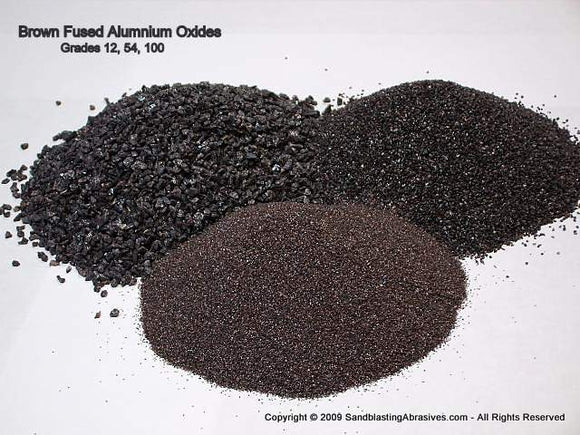
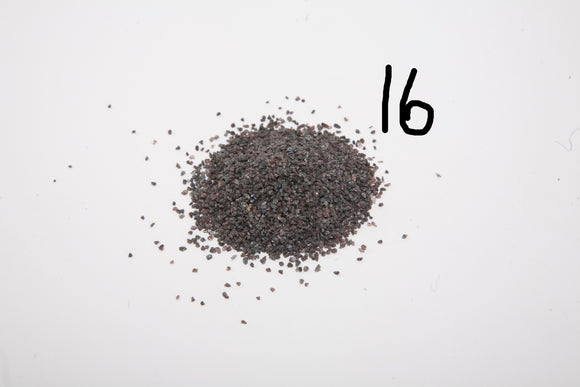
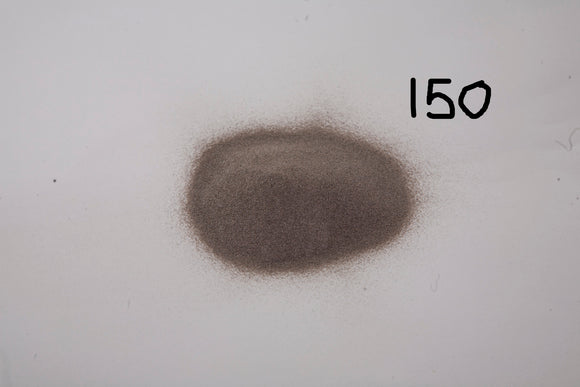


Brown Fused Aluminum Oxide Blasting Media
Tough, durable abrasive grain for aggressive cleaning, cutting and surface preparation
Brown fused aluminum oxide—also called brown aluminum oxide, brown fused alumina, BFA or Al₂O₃ abrasive grain—is a hard, durable blasting and finishing abrasive manufactured by fusing high-quality bauxite in an electric arc furnace.
Its combination of Mohs 9 hardness, high toughness and durable blocky grain makes it an excellent choice for removing rust, paint, mill scale and other stubborn surface contamination. It is suitable for pressure blasting, suction blasting, wet blasting, bonded abrasives, coated abrasives, lapping and selected refractory applications.
Product highlights
- Approximately 95.5%–96% aluminum oxide
- Mohs hardness: 9
- Tough, durable and suitable for repeated blasting cycles
- Strong cutting action with less rapid breakdown than more friable abrasives
- Available in coarse, medium, fine and microgrit sizes
- Suitable for wet or dry processing
- Nonflammable and insoluble in water
- Useful on metal, glass, stone, ceramics and selected composites
- Great for antiskid, anti-slip flooring coatings, additive for epoxy floor systems.
- Commercial, industrial and hobbyist quantities available by grit
- Fast and effective for removing rust, mil scale, paint, carbon deposits
- Will remove deposits from your substrate at twice the speed as sand, without all the health risks.
Brown fused alumina is produced by electric-arc fusion, followed by cooling, crushing, grading, optional treatment, blending and packaging.
Due to its high toughness (low friability), brown fused aluminum oxides are recommended for use in bonded abrasives such as grinding wheels and cutoff wheels, coated abrasives (paper & cloth), sandblasting abrasives, as well as refractory applications.
Tough, long-lasting for cleaning, deburring and surface preparation of metals, ceramics, glass, stone, wood, rubber, plastics and composite materials. Softer substrates require finer grit, lower pressure and testing before production.
Why Choose Brown Fused Aluminum Oxide?
Brown fused aluminum oxide provides a useful balance between cutting speed, toughness and service life.
Unlike round glass bead, which primarily peens and brightens a surface, brown aluminum oxide has an angular-to-blocky cutting structure that removes material and creates an anchor profile. Compared with silicon carbide, it is generally tougher and less friable, making it a strong choice where abrasive reuse and operating cost matter.
Best suited for
| Requirement | Why BFA works |
|---|---|
| Removing heavy rust or coatings | Hard grain produces aggressive cutting action |
| Preparing metal for paint or powder coating | Creates a clean, textured surface for coating adhesion |
| Reclaimable blast cabinets | Durable grain can survive multiple cycles when properly separated and cleaned |
| Deburring and edge preparation | Hard particles remove burrs and sharp irregularities |
| Etching glass or stone | Fine grades (often White Fused AO is used here) provide controlled engraving and matte finishes |
| Grinding and cutting products | High toughness works well in wheels, discs, points and coated abrasives |
| Refractory mixes | High-alumina grades provide hardness and temperature resistance |
Industrial Uses
- Rust, scale and corrosion removal
- Paint and powder-coating removal
- Structural steel surface preparation
- Cleaning castings and forgings
- Weld cleaning and heat-scale removal
- Deburring machined or stamped parts
- Surface profiling before thermal spray or coating
- Blast-room and reclaim-system operations
- Bonded grinding wheels and cutoff wheels
- Coated abrasive paper, belts and cloth
- Loose-grain lapping and precision finishing
- Refractory castables and wear-resistant linings
- Popular for Cerakote surface preparation: Brown fused aluminum oxide produces a clean, consistent anchor profile on metal before ceramic coating.
Homeowner and Hobbyist Uses
Brown aluminum oxide is also useful for smaller restoration and fabrication projects when used in suitable blasting equipment.
- Restoring rusty garden tools and shop tools
- Cleaning antique hardware, hinges and brackets
- Refinishing wrought-iron furniture and railings
- Removing coatings from automotive and motorcycle parts
- Preparing bicycle frames and metal components for painting
- Cleaning cast-iron machinery and equipment parts
- Removing scale from fabricated steel projects
- Etching decorative designs into glass
- Engraving stone, tile and masonry
- Texturing wood signs at reduced pressure
- Cleaning pottery, ceramic or sculpture surfaces
- Preparing knife blanks and fabricated tools before coating or finishing
- Small-part deburring in cabinet blasting systems
- Lapping and precision finishing with fine or microgrit material
Brown aluminum oxide is an aggressive abrasive. Very thin sheet metal, delicate castings, glass and soft materials can be damaged by excessive pressure or grit that is too coarse.
Grit Selection Guide
The correct grit depends on the substrate, coating thickness, blast pressure, nozzle size, desired finish and whether the abrasive will be reclaimed.
| Grit range | Relative action | Typical uses |
|---|---|---|
| 8–24 grit | Extremely coarse and aggressive | Heavy scale, thick coatings, severe corrosion, heavy castings and rough stone texturing |
| 30–46 grit | Aggressive general-purpose cutting | Rust and paint removal, weld cleanup, fabrication work and heavy surface preparation |
| 54–80 grit | Medium cutting and controlled profiling | General blast-cabinet work, powder-coat preparation, automotive parts and deburring |
| 90–120 grit | Fine cutting and smoother finish | Fine surface preparation, lighter coatings, glass etching, small parts and decorative finishes. Popular for Cerakote surface preparation: 100-grit brown fused aluminum oxide produces a clean, consistent anchor profile on metal before ceramic coating. |
| 150–240 grit | Very fine finishing | Precision blasting, fine matte finishes, detailed engraving and controlled surface refinement |
| F280–F1200 | Microgrit | Lapping, polishing, bonded or coated abrasives and specialized precision processes |
Practical starting points
- For heavy rust or thick paint, begin around 30 or 36 grit.
- For general-purpose cabinet blasting and coating preparation, 46, 54 or 60 grit are common starting points.
- For finer automotive parts, engraving or smoother finishes, consider 80 through 120 grit.
- Popular for Cerakote surface preparation: 100-grit brown fused aluminum oxide produces a clean, consistent anchor profile on metal before ceramic coating.
- Always test the least aggressive practical combination first. A blast cabinet is not a time machine; once the surface is gone, it stays gone.
Available Grit Sizes
Common macrogrits - 50lb box: 8, 10, 12, 14, 16, 20, 24, 30, 36, 46, 54, 60, 70, 80, 90, 100, 120, 150, 180, 220 and 240
Microgrits - 25lb boxes - order off this link: F280, F320, F360, F400, F500, F600, F800, F1000 and F1200
Technical Data
The following values summarize the attached supplier technical sheets. They are typical values rather than guaranteed specifications. Chemistry and physical properties may vary by grade, grit, production source and lot.
| Property | Typical value |
|---|---|
| Material | Brown fused aluminum oxide / brown fused alumina |
| Chemical formula | Primarily Al₂O₃ |
| Typical Al₂O₃ | Approximately 95.5%–96.1% |
| Typical TiO₂ | Approximately 2.4%–2.84% |
| Typical SiO₂ | Approximately 0.75%–1.0% |
| Typical Fe₂O₃ | Approximately 0.12%–0.22% |
| Crystal structure | Alpha-alumina macrocrystals |
| Grain shape | Blocky to angular |
| Color | Brown to dark brown/gray |
| Mohs hardness | 9 |
| Knoop hardness | Approximately 2,100 kg/mm² |
| Specific gravity | Approximately 3.87–3.95 g/cm³ |
| Loose bulk density | Approximately 1.56–2.13 g/cm³, depending on grit and grade |
| Melting point | Approximately 2,020–2,040°C / 3,668–3,704°F |
| Water solubility | Insoluble |
| Flammability | Nonflammable |
| Odor | Odorless |
| Standard sizing | ANSI B74.12 and/or FEPA 42-1, depending on product |
Typical Loose Bulk Density
Bulk density is not the same as particle density or specific gravity. It represents the approximate weight of freely poured abrasive per unit volume and normally decreases as grit becomes finer.
The following chart comes from the attached Lionblast technical sheet and should be identified as typical supplier data, not a guaranteed value for every BFA grade.
| Grit | Bulk density g/cm³ | Grit | Bulk density g/cm³ |
|---|---|---|---|
| 8 | 2.03–2.13 | 60 | 1.74–1.88 |
| 10 | 1.97–2.12 | 70 | 1.72–1.86 |
| 12 | 1.94–2.09 | 80 | 1.71–1.85 |
| 14 | 1.92–2.07 | 90 | 1.67–1.81 |
| 16 | 1.90–2.05 | 100 | 1.64–1.78 |
| 20 | 1.87–2.03 | 120 | 1.63–1.77 |
| 24 | 1.85–1.99 | 150 | 1.62–1.76 |
| 30 | 1.81–1.95 | 180 | 1.60–1.74 |
| 36 | 1.79–1.93 | 220 | 1.58–1.72 |
| 46 | 1.77–1.91 | 240 | 1.56–1.70 |
| 54 | 1.76–1.90 |
Specifications and Certifications
Certain U.S.-manufactured grades may be supplied to or certified against, please ask that a COA be sent to you in the comment section of order form when you order.
- AA-59316, Type I, Grades A, B and C
- ANSI B74.12 grit-size requirements
- FEPA 42-1 sizing requirements
- Selected GE Aircraft Engine specifications
- Selected Pratt & Whitney material specifications
Frequently Asked Questions:
- Is brown aluminum oxide reusable? Yes, it can often be reused in enclosed blasting systems. Its high toughness gives it a longer blasting life than many more friable abrasives. Reuse depends on impact pressure, substrate contamination, dust separation and how much the grains have broken down.
- What is the difference between brown and white aluminum oxide? Brown fused aluminum oxide is generally tougher and more durable. It is often selected for aggressive cleaning, general blasting and repeated use.
- White fused aluminum oxide is typically more chemically pure and more friable. It fractures more readily to expose fresh cutting edges and is often chosen for precision finishing or applications where higher purity is important.
- Is brown aluminum oxide the same as silicon carbide? No. Silicon carbide is generally sharper and cuts very quickly, but it is usually more friable. Brown aluminum oxide is tougher and can provide longer service life in reclaim systems.
- Can it remove rust and paint? Yes. Coarse and medium sizes are widely used to remove rust, scale, paint and other coatings from steel and cast metal.
- Can it be used on aluminum parts? Yes, but the grit and pressure must be controlled. Start with a finer grade and lower pressure to reduce the risk of excessive profiling or distortion.
- Can it etch glass? Yes. Fine brown aluminum oxide can create etched, frosted or engraved effects on glass. Glass thickness, nozzle distance, pressure and dwell time must be carefully controlled.
- Can it be used on wood? Yes, but it cuts wood aggressively. Fine grit and low pressure may be used to texture signs, expose grain or remove coatings. Always test on scrap material first.


