



White Fused Aluminum Oxide Blasting Media
High-purity, sharp-cutting abrasive for precision blasting, etching and surface finishing
White fused aluminum oxide—also called white aluminum oxide, white fused alumina, WFA or white A/O—is a high-purity abrasive produced by fusing calcined alumina in an electric arc furnace.
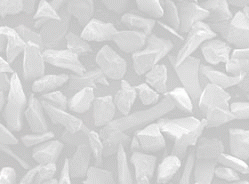
Its sharp, angular grain cuts quickly and fractures during use to expose new cutting edges. This self-renewing action makes white aluminum oxide especially useful for precision surface preparation, fine finishing and applications where minimizing iron or dark-colored contamination is important.
Depending on the grade and supplier, typical aluminum oxide content ranges from approximately 99.4% to 99.8%, with very low iron content.
Product highlights
- High-purity white fused aluminum oxide
- Sharp, angular grain
- Fast cutting action
- Fractures to continually expose fresh cutting edges
- Very low iron content
- Clean white color
- Suitable for wet or dry processing
- Available in macrogrits and microgrits
- Useful for blasting, grinding, lapping, etching and refractory products
- Nonflammable
- Insoluble in water
- Stable under normal storage and handling conditions
Why Choose White Fused Aluminum Oxide?
White aluminum oxide is selected when purity, cutting quality and surface cleanliness matter more than maximum abrasive life.
White Aluminum Oxide vs. Brown Aluminum Oxide - Neither material is automatically “better.” White aluminum oxide is the precision tool; brown aluminum oxide is the workhorse.
| Property | White fused aluminum oxide | Brown fused aluminum oxide |
|---|---|---|
| Typical purity | Approximately 99.4%–99.8% Al₂O₃ | Approximately 95%–96% Al₂O₃ |
| Iron content | Very low | Higher than white alumina |
| Grain behavior | More friable and self-sharpening | Tougher and more durable |
| Cutting action | Sharp, fast and clean | Aggressive and long-lasting |
| Reuse potential | Reusable, but breaks down faster - highly friable | Generally better for repeated blast cycles |
| Surface appearance | Clean, light-colored finish | May leave darker abrasive residue |
| Best use | Precision and contamination-sensitive work | Heavy cleaning and general-purpose blasting |
| Relative cost | Normally higher | Normally more economical |
Common Industrial Applications
Abrasive Blasting and Surface Treatment
- Cleaning stainless steel
- Cleaning aluminum and nonferrous components
- Removing light rust, oxidation and scale
- Removing paint, powder coating and surface residue
- Preparing metal before coating, bonding or plating
- Producing controlled anchor profiles
- Cleaning investment castings
- Deburring machined components
- Matte finishing
- Wet blasting and vapor honing
- Precision cabinet blasting
- Surface preparation where dark abrasive contamination is undesirable
Bonded and Coated Abrasives
- Grinding wheels
- Mounted points
- Cutoff wheels
- Abrasive belts
- Abrasive discs
- Sandpaper and coated abrasive cloth
- Surface grinding
- Cylindrical grinding
- Profile grinding
- Gear grinding
- Thread grinding
- Creep-feed grinding
Precision and Specialty Applications
- Loose-grain lapping
- Fine polishing and pre-polishing
- Optical and technical glass finishing
- Ceramic component finishing
- Semiconductor-related manufacturing
- Wear-resistant products
- Refractory castables
- High-alumina ceramic formulations
- Nonslip flooring and light-colored traction surfaces
- Contamination-sensitive manufacturing
Homeowner, Hobbyist and Small-Shop Uses
White aluminum oxide is particularly useful in smaller blast cabinets and precision finishing systems. Remember it is highly friable vs brown fused.
Restoration and Fabrication
- Cleaning aluminum automotive and motorcycle parts
- Restoring bicycle components
- Cleaning stainless-steel hardware
- Removing oxidation from metal trim
- Preparing small fabricated parts for paint or powder coating
- Cleaning brackets, hinges, handles and decorative hardware
- Deburring machined hobby parts
- Refinishing tools without introducing dark-colored abrasive residue
Glass and Decorative Work
- Glass etching
- Frosting glass
- Decorative engraving
- Etching mirrors
- Engraving tile and ceramic
- Producing matte finishes on stone
- Carving memorial, craft and decorative stone
- Creating texture in light-colored epoxy or resin flooring
Jewelry and Metal Craft
- Cleaning cast jewelry components
- Preparing metal before plating
- Removing investment residue from castings
- Producing satin finishes
- Texturing silver, brass and other metals
- Cleaning small precision parts
Use a test piece first. White aluminum oxide is sharp enough to erase detail remarkably efficiently—which is impressive right up until the detail was something you wanted to keep.
Knife Making and Precision Metalwork
- Cleaning forged or heat-treated scale
- Preparing knife blanks before coating
- Creating controlled matte finishes
- Cleaning fixtures and small tooling
- Deburring cut or machined edges
Lapidary, Lapping and Tumbling
Fine and microgrit white aluminum oxide may be used for:
- Flat lapping
- Precision fitting
- Surface refinement
- Lapidary pre-polishing
- Vibratory finishing
- Fine ceramic finishing
Blast-grade aluminum oxide should not automatically be treated as lapidary polish. Particle distribution, purity and grit standard must match the intended lapping or polishing process.
Grit Selection Guide
The best grit depends on the substrate, coating, equipment, blast pressure and desired surface finish.
| Grit range | Cutting action | Typical applications |
|---|---|---|
| 10–24 grit | Extremely coarse and aggressive | Heavy scale, thick coatings, rough castings and coarse texturing |
| 30–46 grit | Aggressive | Rust and coating removal, weld cleaning and heavy surface preparation |
| 50–80 grit | Medium | General cabinet blasting, deburring, coating preparation and metal finishing |
| 90–120 grit | Fine | Aluminum and stainless components, glass etching and smoother profiles |
| 150–240 grit | Very fine | Precision blasting, decorative finishes, delicate parts and fine surface refinement |
| F240–F400 | Microgrit | Lapping, fine coated abrasives and controlled polishing |
| F500–F800 | Fine microgrit | Precision finishing, pre-polishing and specialty abrasive products |
Practical starting recommendations
- Heavy coating removal - Start around 30 or 36 grit.
- General blast-cabinet work - Start around 54, 60 or 80 grit.
- Aluminum parts - Start around 80 or 100 grit at moderate pressure.
- Stainless-steel finishing - Consider 80 through 120 grit, depending on the required profile.
- Glass etching - Consider 100 through 180 grit for controlled frosting and engraving.
- Fine decorative work
- Consider 150 through 240 grit.
Lapping and precision finishing
Use an appropriate FEPA F-microgrit (order in 25lb boxes here) rather than assuming a blasting grit will produce the same result.
Available Grit Sizes
Macrogrits: 10, 12, 14, 16, 20, 22, 24, 30, 36, 40, 46, 54, 60, 70, 80, 90, 100, 120, 150, 180, 220 and 240
Microgrits: F240, F280, F320, F360, F400, F500, F600, F800, F1200
Technical Data
| Property | Typical value |
|---|---|
| Product | White fused aluminum oxide |
| Common names | White fused alumina, white A/O, WFA |
| Chemical formula | Al₂O₃ |
| CAS number | 1344-28-1 |
| Crystal structure | Alpha alumina |
| Typical Al₂O₃ | Approximately 99.42%–99.78% |
| Broader SDS minimum | At least 98% Al₂O₃ |
| Typical Fe₂O₃ | Approximately 0.03%–0.04% |
| Typical Na₂O | Approximately 0.18%–0.43% |
| Grain shape | Angular |
| Color | White |
| Cutting quality | High |
| Toughness | Medium |
| Supplier-reported Knoop 100 hardness | Approximately 1,900 |
| Specific gravity | Approximately 3.94 g/cm³ |
| Relative density | Approximately 3.97 at 20°C |
| Melting point | Approximately 2,040°C / 3,704°F |
| Water solubility | Insoluble |
| Flammability | Nonflammable |
| Odor | Odorless |
| Typical macrogrit bulk density | Approximately 1.43–1.88 g/cm³ |
| Sizing standards | FEPA, ISO and ANSI, depending on grade |
Typical Loose Bulk Density
| Grit | Bulk density g/cm³ | Grit | Bulk density g/cm³ |
|---|---|---|---|
| 10 | 1.70–1.80 | 60 | 1.63–1.73 |
| 12 | 1.70–1.80 | 70 | 1.62–1.72 |
| 14 | 1.72–1.82 | 80 | 1.59–1.69 |
| 16 | 1.74–1.84 | 90 | 1.58–1.68 |
| 20 | 1.78–1.88 | 100 | 1.55–1.65 |
| 22 | 1.78–1.88 | 120 | 1.52–1.62 |
| 24 | 1.77–1.87 | 150 | 1.50–1.60 |
| 30 | 1.75–1.85 | 180 | 1.46–1.56 |
| 36 | 1.73–1.83 | 220 | 1.44–1.54 |
| 40 | 1.72–1.82 | 240 | 1.43–1.53 |
| 46 | 1.70–1.80 | ||
| 54 | 1.66–1.76 |


