


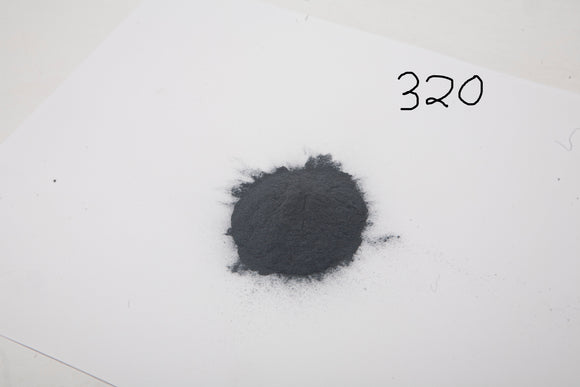


Brown Fused Aluminum Oxide Microgrits F280 - F1200 — 25lb Box
Fine, high-toughness brown fused alumina for abrasive manufacturing and controlled finishing applications
Order fine brown fused aluminum oxide microgrit in convenient 25 lb boxes.
Brown fused aluminum oxide—also called brown fused alumina, brown aluminum oxide or BFA—is manufactured by reducing high-quality bauxite in an electric arc furnace. The resulting alpha-alumina abrasive combines high hardness with the toughness associated with brown fused alumina.
Product Highlights
- Fine brown fused aluminum oxide microgrit
- Nine available sizes from F280 through F1200
- Convenient 25 lb ordering quantity, 200-400lb drums, or 2000 lb supersacks
- Approximately 95%+ aluminum oxide
- Mohs hardness of 9
- High-toughness abrasive grain
- Alpha-alumina crystal structure
- Suitable for bonded and coated abrasive production
- Suitable for selected blasting and surface-treatment processes
- Suitable for refractory applications
- Insoluble in water
- Nonflammable
- Not regulated as dangerous goods for standard DOT, IATA or IMDG transportation under the supplied SDS
Common Applications
Bonded Abrasive Manufacturing
Fine brown fused aluminum oxide may be used as abrasive grain in products such as:
- Grinding wheels
- Cutoff wheels
- Mounted points
- Abrasive stones
- Specialty bonded finishing products
- Resin- and vitrified-bond abrasive formulations
The correct grade will depend on the desired cutting action, finish and bond system.
Coated Abrasive Manufacturing
Applications may include:
- Abrasive paper
- Abrasive cloth
- Sanding belts
- Sanding discs
- Fine finishing sheets
- Specialty abrasive pads
- Industrial finishing products
Brown fused alumina is valued where abrasive toughness and durability are important.
Fine Blasting and Surface Treatment
Depending on the equipment and selected grit, these fine grades may be considered for:
- Controlled surface cleaning
- Fine abrasive blasting
- Light deburring
- Surface refinement
- Producing matte finishes
- Cleaning small or detailed components
- Wet or dry surface-treatment systems
- Finishing metal, ceramic, glass, stone and composite surfaces
Because these are fine microgrits, equipment compatibility should be verified before ordering. Extremely fine material may not feed reliably through an ordinary siphon blast cabinet.
Refractory and Wear-Resistant Products
Brown fused alumina may also be used in:
- Refractory formulations
- High-alumina mixes
- Wear-resistant materials
- Specialty ceramic products
- Abrasion-resistant fillers
- Industrial formulations requiring hard alumina grain
Final suitability should be established by testing in the intended formulation.
Why Choose Brown Fused Aluminum Oxide?
Brown fused aluminum oxide provides a useful balance between cutting speed, toughness (LOW Friability) and service life (coarser sizes can be recycled).
Unlike round glass bead, which primarily peens and brightens a surface, brown aluminum oxide has an angular-to-blocky cutting structure that removes material and creates an anchor profile. Compared with silicon carbide, it is generally tougher and less friable, making it a strong choice where abrasive reuse and operating cost matter.
White Aluminum Oxide vs. Brown Aluminum Oxide? Neither material is automatically “better.” Think of white fused aluminum oxide as a precision tool; brown aluminum oxide is the workhorse. The difference is mainly in PURITY and FRIABILITY.
| Property | White fused aluminum oxide | Brown fused aluminum oxide |
|---|---|---|
| Typical purity | Approximately 99.4%–99.8% Al₂O₃ | Approximately 95%–96% Al₂O₃ |
| Iron content | Very low | Higher than white alumina |
| Grain behavior | More friable and self-sharpening | Tougher and more durable |
| Cutting action | Sharp, fast and clean | Aggressive and long-lasting |
| Reuse potential | Reusable, but breaks down faster - highly friable | Generally better for repeated blast cycles |
| Surface appearance | Clean, light-colored finish | May leave darker abrasive residue |
| Best use | Precision and contamination-sensitive work | Heavy cleaning and general-purpose blasting |
| Relative cost | Normally higher | Normally more economical |
Brown Fused Aluminum Oxide is suited for
| Requirement | Why BFA works |
|---|---|
| Removing heavy rust or coatings | Hard grain produces aggressive cutting action |
| Preparing metal for paint or powder coating | Creates a clean, textured surface for coating adhesion |
| Reclaimable blast cabinets | Durable grain can survive multiple cycles when properly separated and cleaned |
| Deburring and edge preparation | Hard particles remove burrs and sharp irregularities |
| Etching glass or stone | Fine grades (often White Fused AO or Black Silicon Carbides are used for etching) provide controlled engraving and matte finishes |
| Grinding and cutting products | High toughness works well in wheels, discs, points and coated abrasives |
| Refractory mixes | High-alumina grades provide hardness and temperature resistance |
Choosing the Correct Microgrit
The grit designations indicate relative fineness. As the F-number increases, the abrasive becomes progressively finer.
| Available grit | Relative position within this product range | General selection guidance |
|---|---|---|
| F280 | For coarser sizes use this order page | Choose when greater cutting action is preferred |
| F320 | Coarse microgrit | Controlled cutting and early-stage refinement |
| F360 | Moderately coarse microgrit | Fine abrasive products and surface conditioning |
| F400 | Medium microgrit | Balanced cutting and surface refinement |
| F500 | Medium-fine microgrit | Finer finishing and specialty abrasive formulations |
| F600 | Fine microgrit | Reduced cutting depth and smoother refinement |
| F800 | Very fine microgrit | Fine surface treatment and precision formulations |
| F1000 | Extra-fine microgrit | Very fine abrasive and finishing processes |
| F1200 | Finest offered | Minimum cutting within this product range |
This table is relative selection guidance, not a substitute for a verified particle-size distribution.
Specifications and Certifications
Certain U.S.-manufactured grades may be supplied to or certified against, please ask that a COA be sent to you in the comment section of order form when you order.
- AA-59316, Type I, Grades A, B and C
- ANSI B74.12 grit-size requirements
- FEPA 42-1 sizing requirements
- Selected GE Aircraft Engine specifications
- Selected Pratt & Whitney material specifications
Frequently Asked Questions:
- Is brown aluminum oxide reusable? Yes, it can often be reused in enclosed blasting systems. Its high toughness gives it a longer blasting life than many more friable abrasives. Reuse depends on impact pressure, substrate contamination, dust separation and how much the grains have broken down.
- What is the difference between brown and white aluminum oxide? Brown fused aluminum oxide is generally tougher and more durable. It is often selected for aggressive cleaning, general blasting and repeated use.
- White fused aluminum oxide is typically more chemically pure and more friable. It fractures more readily to expose fresh cutting edges and is often chosen for precision finishing or applications where higher purity is important.
- Is brown aluminum oxide the same as silicon carbide? No. Silicon carbide is generally sharper and cuts very quickly, but it is usually more friable. Brown aluminum oxide is tougher and can provide longer service life in reclaim systems.
- Can it remove rust and paint? Yes. Coarse and medium sizes are widely used to remove rust, scale, paint and other coatings from steel and cast metal.
- Can it be used on aluminum parts? Yes, but the grit and pressure must be controlled. Start with a finer grade and lower pressure to reduce the risk of excessive profiling or distortion.
- Can it etch glass? Yes. Fine brown aluminum oxide can create etched, frosted or engraved effects on glass. Glass thickness, nozzle distance, pressure and dwell time must be carefully controlled. Black Silicon Caribide and White Fused Aluminum oxides are also often used depending on substrate.
- Can it be used on wood? Yes, but it cuts wood aggressively. Fine grit and low pressure may be used to texture signs, expose grain or remove coatings. Always test on scrap material first.


