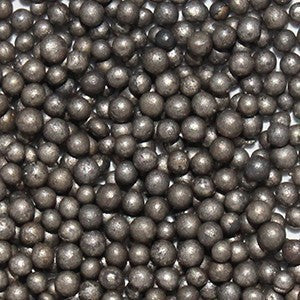
High Carbon Cast Steel Shot – SAE J444 & J827
High carbon cast steel shot is a durable, reusable blasting abrasive used for demanding industrial cleaning and surface preparation applications. Available in a broad range of SAE steel shot sizes from S70 through S780, high carbon steel shot is commonly used for desanding castings, descaling steel, cleaning forgings and preparing metal surfaces.
High Carbon Cast Steel Shot is produced with controlled atomizing and air-quenching processes designed to create highly spherical particles with minimal defects, voids and cracks. Its tempered martensitic microstructure provides strong durability and resistance to fatigue, while the spherical shape promotes consistent impact and efficient blasting durable, reusable metallic blasting abrasive. Designed for blast cleaning, descaling, deburring, surface preparation and shot peening of steel and other ferrous components.
Manufactured with a tempered martensitic microstructure and a standard hardness of approximately 40–50 HRC (average approximately 45 HRC), high carbon steel shot provides the impact energy and durability required for demanding industrial blasting applications.
Available in SAE shot sizes S780 through S70, with special hardness ranges available upon request.
High Carbon Steel Shot Specifications
-
Material: High Carbon Cast Steel Shot
-
Hardness: 40–51 HRC (390-530 HV)
-
Average Hardness: Approximately 45 HRC
-
Microstructure: Tempered Martensite (with minimum 15% residual austenite)
-
Available Sizes: SAE S70 through S780
- Chemical Composition: carbon 0.8–1.2%, silicon 0.4–1.2%, sulfur <0.05%, phosphorus <0.05%, with manganese varying somewhat by shot size
- Minimum density >7.0 g/cm³ and conductivity <30 µS/cm
-
Standards: SAE J444 and SAE J827
-
Shape: Round / spherical shot
-
Special Hardness: Available by special order
-
Packaging / Sales Quantity: Sold by net ton – 2,000 lbs. 2,000-lb drum, 2,205-lb big bag, or palletized 55-lb bags
What Is High Carbon Steel Shot Used For?
High carbon cast steel shot is widely used in wheel-blast and other reusable metallic abrasive systems where rapid cleaning and consistent surface treatment are required.
Typical applications include:
- Removing mill scale from steel
- Removing rust and oxidation
- Cleaning steel castings
- Cleaning forgings
- Foundry desanding and casting cleanup
- Scale removal after heat treatment
- Deburring metal components
- Surface preparation before coating or painting
- Shot peening (Low carbon often works better for this application)
- Producing a uniform blasted or peened finish
- General industrial steel cleaning
- Foundries, forges, steel mills and automotive applications
- Performance Characteristics: air quenched, high sphericity, reduced machine wear, homogeneous microstructure, resistance to fatigue, minimal voids/cracks, reusable and recyclable
Because steel shot is rounded rather than sharply angular, it impacts the workpiece differently than steel grit. Steel shot is particularly useful when the objective is cleaning, peening or producing a more uniform dimpled surface rather than creating the aggressive etched profile associated with angular grit. Check Current Inventory & Delivered Price.
High Carbon Steel Shot vs. Steel Grit
Choosing between steel shot and steel grit depends primarily on the surface profile and cleaning action required.
High carbon steel shot is rounded and delivers an impact or peening action. It is commonly selected for general cleaning, descaling, casting cleanup and shot peening.
Steel grit is angular and produces a more aggressive cutting action. It is commonly selected where a deeper anchor profile or more aggressive surface etching is required.
High Carbon vs Low Carbon Steel Shot — Which Is Right for Your Application?
Both high carbon and low carbon steel shot are durable, reusable abrasives for industrial blast cleaning. The best choice depends on your equipment, cleaning requirements, desired surface finish, and operating priorities.
| What Matters to You? |
High Carbon Steel Shot |
Low Carbon Steel Shot |
| Best Choice When You Want |
Strong impact performance, resilience, and reliable cleaning in demanding blast applications |
Long media life, reduced machine wear, and lower dust generation |
| Cleaning Performance |
Excellent impact and cleaning power for demanding industrial applications |
Effective cleaning with a somewhat gentler wear profile |
| Media Durability |
Highly durable and engineered for strong resistance to fatigue |
Highly durable and designed to wear gradually with reduced breakage |
| Blast Machine Wear |
High sphericity helps reduce wear while maintaining strong impact performance |
Excellent choice when reducing wear on blast wheels, blades, and machine components is a priority |
| Dust Generation |
Durable shot minimizes premature breakdown during repeated blasting cycles |
Especially attractive for operations looking to reduce dust and filtration demands |
| Operating Cost Considerations |
Excellent performance and recyclability for high-production blasting |
Can help reduce operating costs through lower machine wear, reduced dust, and long media life |
| Typical Uses |
Desanding, descaling, casting cleaning, steel cleaning, surface preparation, and heavy industrial blasting |
Foundry cleaning, desanding, deburring, descaling, casting cleaning, and general industrial blasting |
| Common Industries |
Foundries, steel mills, automotive, forging, fabrication, and general manufacturing |
Foundries, automotive, forging, metalworking, wind energy, and general manufacturing |
| Microstructure |
Tempered martensite |
Tempered bainite |
| Typical Hardness |
40–51 HRC |
40–50 HRC |
| Available SAE Sizes |
S70 through S780 |
S70 through S780 |
| Reusable & Recyclable |
Yes |
Yes
|
Choosing a Steel Shot Size
SAE steel shot sizes are designated with an “S” number, such as S70 steel shot, S110 steel shot, S170 steel shot, S230 steel shot, S280 steel shot, S330 steel shot, S390 steel shot, S460 steel shot, S550 steel shot, S660, and S780 steel shot.
In general Smaller steel shot is useful for:
- Smaller components
- Finer cleaning
- Tighter areas
- Smoother surface finishes
Larger steel shot provides:
- Greater impact energy
- More aggressive scale removal
- Faster cleaning on heavier steel components
- Greater peening
As the SAE shot number increases, the shot becomes larger and delivers greater impact energy. Smaller shot generally produces a finer finish and provides better coverage on smaller or more detailed parts.
| SAE Size |
Approx. Nominal Diameter |
Approx. Inches |
Relative Size |
Typical Use |
| S70 |
0.18 mm |
0.007" |
Very Fine |
Fine cleaning, light peening, small or delicate parts |
| S110 |
0.28–0.30 mm |
0.011–0.012" |
Fine |
Precision cleaning, small components, light deburring |
| S170 |
0.43 mm |
0.017" |
Fine/Medium |
General cleaning, lighter descaling, shot peening |
| S230 |
0.58–0.60 mm |
0.023–0.024" |
Medium |
General-purpose cleaning, surface preparation and peening |
| S280 |
0.71 mm |
0.028" |
Medium/Coarse |
Foundry cleaning, scale removal and heavier components |
| S330 |
0.84–0.85 mm |
0.033" |
Coarse |
More aggressive cleaning, heavier steel components and peening |
Check Current Inventory & Delivered Price.