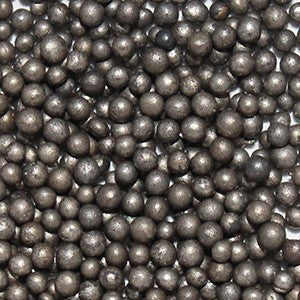
A durable, low-dust cast steel blasting media designed for cleaning, descaling, and surface preparation in wheel-blast equipment, with excellent fatigue life and reduced breakdown compared with conventional high-carbon steel shot.
Low Carbon: tends to wear gradually with very low fracture rates. Are you instead looking for Ultra SOFT Shot?
High Carbon: fatigue behavior depends on hardness and operating mix; conventional high-carbon shot may fracture more readily as it reaches the end of its useful life.
| Specification |
Low Carbon Cast Steel Shot |
| Carbon |
0.10–0.15% |
| Silicon |
0.10–0.25%* varies by size |
| Manganese |
1.20–1.50% |
| Aluminum |
0.05–0.15% |
| Sulfur |
≤0.035% |
| Phosphorus |
≤0.035% |
| Hardness |
40–50 HRC |
| Microstructure |
Tempered bainite |
| SAE Sizes |
S70–S780 |
| Sizing Standard |
SAE J444 |
| Density |
Minimum 7 g/cc |
Low Carbon vs. High Carbon Cast Steel Shot
Both low-carbon and high-carbon cast steel shot are reusable metallic abrasives used in wheel-blast equipment for cleaning, descaling, desanding and surface preparation. The primary difference is the carbon content and resulting microstructure, which affects how the shot behaves after repeated impacts.
Beneftis of low carbon steel shot include reduced blast-machine wear, lower operating cost, and less dust. (The lower hardness/breakage reduces wear on blast-wheel components and that reduced dust can lower filtration and maintenance requirements).
| Feature |
Low Carbon Cast Steel Shot |
High Carbon Cast Steel Shot |
| Carbon Content |
Typically about 0.10–0.15% |
Typically about 0.8–1.2% |
| Typical Microstructure |
Bainitic |
Tempered martensitic |
| Typical Hardness |
Approximately 40–50 HRC |
Approximately 40–51 HRC, with harder grades available |
| Behavior During Use |
Tends to deform and wear gradually |
More likely to eventually fracture into smaller particles |
| Media Breakdown |
Low |
Generally higher |
| Dust Generation |
Typically lower |
Typically higher as particles fracture |
| Blast Machine Wear |
Can reduce wear on wheel blades, liners and other components |
Potentially higher wear depending on hardness and operating conditions |
| Media Consumption |
Often lower due to resistance to breakage |
Application dependent |
| Cleaning Action |
Controlled, consistent impact cleaning |
Strong impact cleaning; harder versions are available for demanding applications |
| Surface Finish |
Uniform, controlled finish |
Uniform finish with options for higher-impact applications |
| Recyclability |
Highly recyclable in properly designed blast systems |
Highly recyclable in properly designed blast systems |
| Common Applications |
Foundries, desanding, forgings, automotive castings, general metal cleaning |
Foundries, forgings, steel mills, automotive components, descaling and heavy-duty cleaning |
Why Choose Low Carbon Steel Shot?
Low-carbon cast steel shot is engineered for durability. Its bainitic microstructure allows the individual shot particles to absorb repeated impacts and gradually wear rather than rapidly fracture.
For many wheel-blasting operations, this can provide several advantages:
-
Long media life and potentially lower abrasive consumption
-
Reduced dust generation from fractured abrasive
- Less wear on blast-wheel components, liners and other machine parts
-
Stable operating mix for consistent blasting performance
- Effective removal of sand, scale, rust and other surface contaminants
-
Reusable and recyclable in properly equipped blast systems
Low-carbon steel shot is particularly well suited to foundry desanding, casting cleanup, forging cleanup, heat-treatment scale removal and general production blasting where durability and operating cost are important considerations.
High-carbon cast steel shot remains an excellent choice for many conventional and heavy-duty blasting operations. Its tempered martensitic structure provides high impact strength, and specialized higher-hardness grades can be selected when more aggressive cleaning or shot-peening performance is required.
High-carbon steel shot is commonly used for:
- Heavy scale removal
- Steel mill applications
- Forgings and castings
- Automotive components
- General-purpose wheel blasting
- Selected shot-peening applications
Which Steel Shot Should I Use?
The best abrasive depends on more than carbon content. Part material, contaminant or scale thickness, desired surface finish, blast-wheel horsepower, abrasive size and the operating mix inside the machine all affect performance.
Choose low-carbon steel shot when reducing abrasive breakdown, dust, media consumption and blast-machine wear are priorities.
Choose high-carbon steel shot when the application calls for traditional high-impact cleaning, specialized hardness levels or demanding peening and descaling performance.
Low Carbon Steel Shot Sizes – SAE S70 to S780
Low carbon cast steel shot is available in SAE sizes S70 through S780, with sieve analysis based on SAE J444. (S70, S110, S170, S230, S280, S330, S390, S460, S550, S660 & S780)
| SAE Size |
Approx. Nominal Size (inches) |
Approx. Nominal Size (mm) |
| S-70 |
0.007 |
0.18 |
| S-110 |
0.011 |
0.30 |
| S-170 |
0.017 |
0.43 |
| S-230 |
0.023 |
0.60 |
| S-280 |
0.028 |
0.71 |
| S-330 |
0.033 |
0.85 |
| S-390 |
0.039 |
1.00 |
| S-460 |
0.046 |
1.18 |
| S-550 |
0.055 |
1.40 |
| S-660 |
0.066 |
1.70 |
| S-780 |
0.078 |
2.00 |
S70 Low Carbon Steel Shot
S70 steel shot is one of the finest low carbon steel shot sizes available. Its small particle size makes it suitable where a finer blast profile, lighter cleaning action, or access to small features is important.
S110 Low Carbon Steel Shot
S110 low carbon steel shot is a fine abrasive size commonly considered for lighter cleaning, deburring, and surface preparation applications where a relatively smooth finish is preferred.
S170 Low Carbon Steel Shot
S170 steel shot provides a step up in impact energy from S110 while remaining relatively fine. It can be useful for general cleaning, desanding, and surface preparation where a balance between cleaning speed and surface finish is desired.
S230 Low Carbon Steel Shot
S230 steel shot, approximately 0.023 inch or 0.60 mm, is a widely used mid-range size for industrial blast cleaning. It offers a useful balance of impact energy, coverage, and surface finish.
S280 Low Carbon Steel Shot
S280 steel shot, approximately 0.028 inch or 0.71 mm, provides greater impact than S230 and can be used where heavier cleaning or more aggressive scale and sand removal is needed.
S330 Low Carbon Steel Shot
S330 steel shot, approximately 0.033 inch or 0.85 mm, is a medium-to-coarse shot size suitable for demanding industrial cleaning applications. It provides more impact energy than the smaller S230 and S280 grades.
S390 Low Carbon Steel Shot
S390 low carbon steel shot, approximately 0.039 inch or 1.00 mm, is a larger shot size intended for heavier-duty blast cleaning where greater impact energy is beneficial.
S460 Low Carbon Steel Shot
S460 steel shot, approximately 0.046 inch or 1.18 mm, provides a strong mechanical impact and is generally suited to heavier castings and more aggressive desanding or descaling work.
S550 Low Carbon Steel Shot
S550 steel shot, approximately 0.055 inch or 1.40 mm, is a coarse low carbon shot size used where high impact is more important than producing a fine surface finish.
S660 Low Carbon Steel Shot
S660 steel shot, approximately 0.066 inch or 1.70 mm, is one of the larger SAE steel shot grades and is best suited to substantial industrial cleaning jobs requiring high impact energy.
S780 Low Carbon Steel Shot
S780 steel shot, approximately 0.078 inch or 2.00 mm, intended for applications where maximum impact from a large spherical steel abrasive is desired.
Due to the heavy weight of this material, you cannot purchase this material online. A custom freight quotation is necessary. Check Current Inventory & Delivered Price.