



Industrial Black Silicon Carbide Abrasive Media
Industry-leading black silicon carbide (SiC) abrasive media engineered for demanding professional applications across manufacturing, surface preparation, coatings, and precision finishing operations.
Primary Industrial Applications
- High-Tech Coatings: Surface preparation for aerospace, automotive, and marine protective coatings
- Anti-Slip Flooring Systems: Aggregate additive for industrial flooring, walkways, and safety surfaces
- Advanced Ceramics Manufacturing: Precision grinding and finishing of technical ceramics, refractory materials
- Precision Lapping & Polishing: Optical components, semiconductor wafers, precision tooling
- Glass Etching & Frosting: Architectural glass, decorative panels, signage applications
- Metal Finishing: Deburring, surface texturing, and preparation for plating operations
Specialized Professional Markets
- Semiconductor Industry: Wafer lapping, CMP slurries, substrate preparation
- Optical Manufacturing: Lens grinding, mirror polishing, precision optics finishing
- Aerospace Components: Turbine blade finishing, composite surface preparation
- Automotive Manufacturing: Engine component lapping, transmission part finishing
- Medical Device Production: Implant surface texturing, surgical instrument finishing
- Electronics Manufacturing: PCB surface preparation, connector finishing
- Refractory Industry: Kiln furniture grinding, furnace component preparation
- Tool & Die Manufacturing: Precision tooling, mold surface preparation
- Glass Etching & Frosting: Architectural glass, decorative panels, signage applications
- Flooring Applications: Anti slip, traction additive, concrete broadcast abrasive
Technical Specifications
- Material Composition: 99.5% pure black silicon carbide (SiC)
- Crystal Structure: Alpha silicon carbide (α-SiC)
- Hardness: 9.5 Mohs scale (2480 Knoop)
- Density: 3.22 g/cm³
- Melting Point: 2700°C (4892°F)
- Thermal Conductivity: 120 W/m·K
- Chemical Resistance: Excellent acid/alkali resistance
- Particle Shape: Sharp, angular crystals for aggressive cutting action
Quality Standards & Certifications
- FEPA Standards: Compliant with European abrasive grain standards
- ANSI Standards: Meets American National Standards Institute specifications
- ISO 9001: Quality management system certified
- Consistent Sizing: Precision graded for uniform performance
- Low Impurities: Minimal free silicon and metallic contamination
Processing Advantages
- Superior Cutting Efficiency: 40% faster material removal than aluminum oxide
- Consistent Performance: Maintains sharp cutting edges throughout use
- Thermal Stability: Excellent performance at elevated temperatures
- Chemical Inertness: Compatible with most processing fluids and environments
- Recyclable: Can be reclaimed and reused in many applications
Lead Times: Usually 4-5 Business Days to repackage for you. No shipping on Fridays so if you order on a Thursday or Friday it will be not be put on the repack schedule until the following Monday (at the earliest). Please bear these long lead times in mind.
Available Grit Sizes
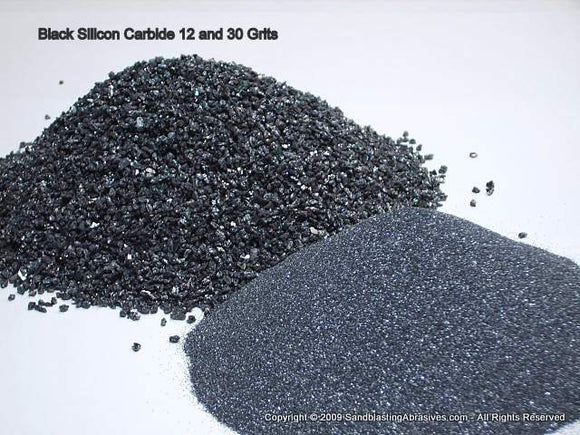
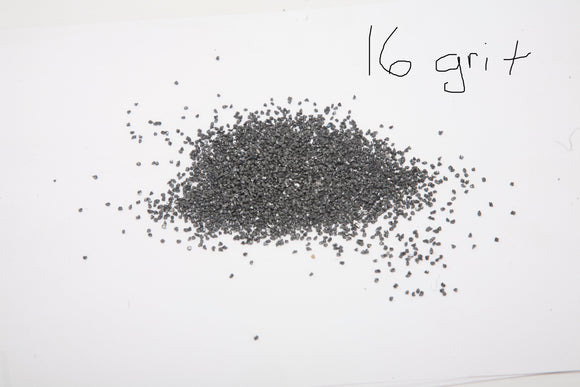
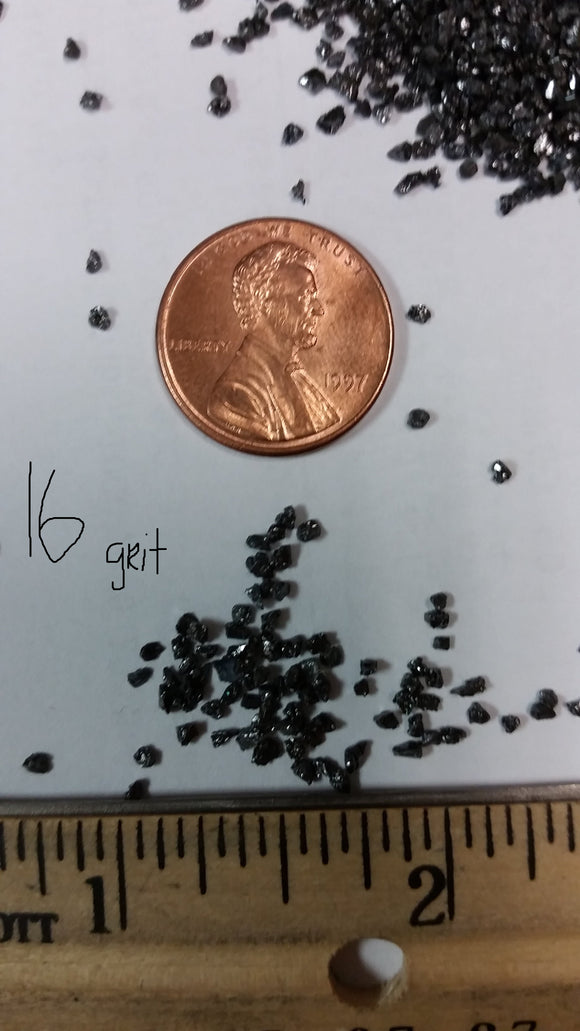
Coarse Grits (8-36): Heavy stock removal, rough grinding, surface preparation, traction
Medium Grits (46-120): Intermediate finishing, deburring, texture development
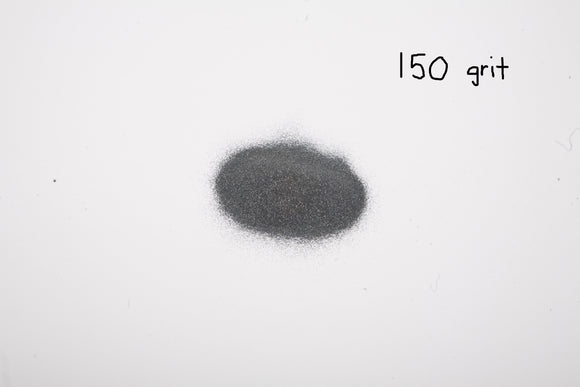
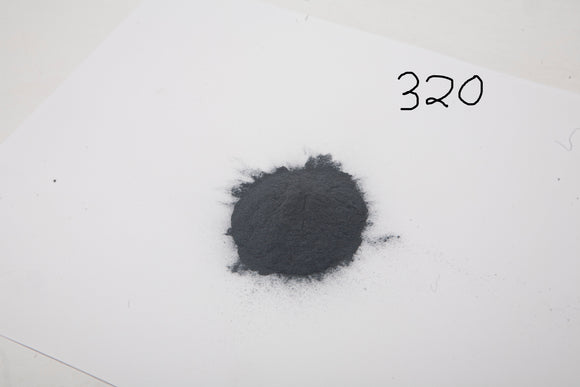
Fine Grits (150-400): Precision lapping, etching, pre-polish operations
Micro Grits (500-1200): Final polishing, optical finishing, ultra-smooth surfaces
Bulk Packaging: 50 lb bags 40/pallet, 300 lb drums 4/pallet, 2,000 lb super sacks
Black Silicon Carbide 16/35 Mesh for Anti-Slip Concrete and Pedestrian Plazas
Black Silicon Carbide 16/35 mesh is an excellent choice for creating durable, slip-resistant surfaces on concrete sidewalks, pedestrian plazas, walkways, ramps, and other high-traffic areas. With a Mohs hardness of approximately 9–9.5, silicon carbide provides exceptional abrasion resistance and long-lasting traction when properly embedded into concrete surfaces. New York City DOT sidewalk specifications identify silicon carbide grit sizes of 16/30 and/or 16/36 mesh for certain concrete applications, demonstrating the material's established use in public pedestrian infrastructure.
Handling and Safety
Black silicon carbide creates airborne dust during pouring, blasting, grinding, mixing and cleanup.
- Avoid breathing dust.
- Use adequate local exhaust or ventilation.
- Wear safety glasses or suitable face protection.
- Wear appropriate gloves and protective clothing.
- Use suitable respiratory protection when ventilation and dust collection are insufficient.
- Do not dry sweep accumulated dust.
- Keep the material dry and store it in a sealed container.
Should I Choose Black Silicon Carbide or Aluminum Oxide?
Choose black silicon carbide when your priority is:
- Maximum hardness
- Sharp, aggressive cutting
- Processing hard or brittle materials
- Lapping, etching, polishing of glass, stone, ceramics or quartz
- Fine powders and precision finishing
- Elevated-temperature strength
Consider brown fused aluminum oxide (low friability) when your priority is:
- A tougher, less brittle grain with high durability and long life.
- Longer media life on many metal surfaces
- General-purpose steel blasting
- Repeated impact without rapid grain fracture
- Choose White fused aluminum oxide is highly friable (breaks down rapidly) making it is great for etching, polishing glass and stone.
Neither abrasive is automatically “better.” The correct choice depends on the substrate and the required surface result. Silicon carbide is the scalpel; aluminum oxide is often the workhorse.
Common Applications:
Abrasive blasting
Use black SiC when a highly aggressive, hard abrasive is needed for etching, cleaning or profiling difficult surfaces.
Because it is harder and more brittle than many general-purpose abrasives, black SiC can cut quickly but may also produce a more aggressive finish. Always test the selected grit on a representative area.
Rock tumbling and lapidary
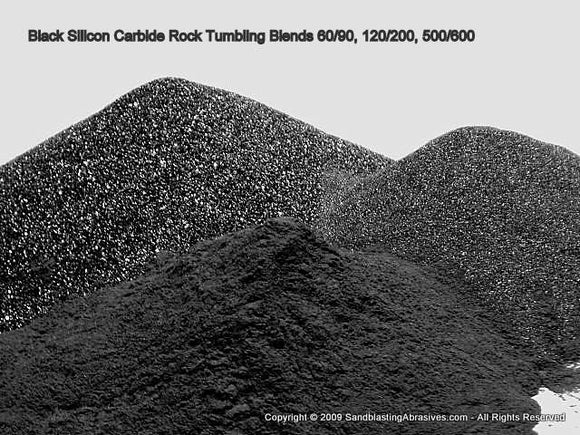
Black SiC is widely suited to grinding and smoothing stone. A typical sequence progresses from coarse material removal to increasingly fine grits before the final polishing compound. As Black SiC breaks down, it reveals sharp edges again, making it great for rock polishing.
A common starting progression is:
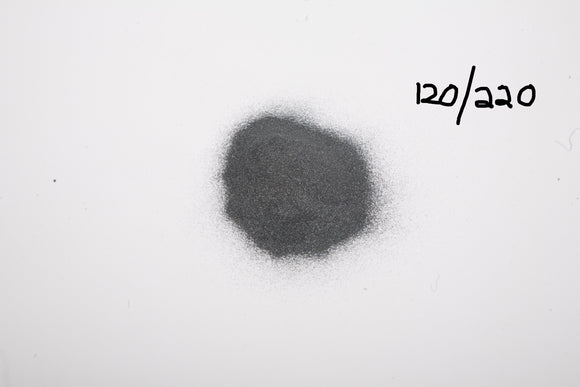
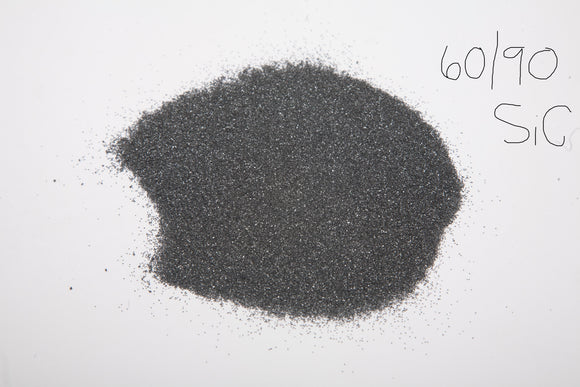
60/90 → 120/220 → fine SiC → pre-polish → final polish
The correct sequence depends on the hardness of the stone, tumbler type, load, barrel size and desired finish.
Grinding wheels and bonded abrasives
Black SiC is used in vitrified and resinoid grinding-wheel systems. Its sharp edges and high hardness make it useful for grinding hard, brittle and nonmetallic materials.
Non-slip surfaces
The angular particles can be incorporated into selected coatings, flooring systems or surface treatments where added texture and traction are required. Confirm compatibility with the coating manufacturer before use.
Lapping and precision finishing
Fine and microgrit SiC powders can be used for:
- Flattening
- Controlled stock removal
- Surface refinement
- Valve and component lapping
- Ceramic finishing
- Glass and quartz processing
- Preparation before polishing
Frequently Asked Questions
What is black silicon carbide?
Black silicon carbide is a synthetic abrasive mineral composed primarily of SiC. It is extremely hard and has sharp, angular cutting edges.
What is black silicon carbide used for?
Common uses include abrasive blasting, rock tumbling, grinding wheels, lapping, polishing, friction products, non-slip surfaces and wire sawing of silicon or quartz.
Is black silicon carbide harder than aluminum oxide?
Yes. Black SiC is generally harder and sharper, while aluminum oxide is usually tougher and less brittle. SiC is often preferred for hard, brittle or nonmetallic materials.
Can black SiC be used in a blasting cabinet?
Yes, provided the cabinet, reclaim system, dust collector, nozzle and protective equipment are compatible with a hard, aggressive abrasive. Test the media before committing to a full production run.
Can silicon carbide be reused?
It may be reused after appropriate screening or reprocessing when the remaining grain shape, size and cleanliness meet the application requirements. Reuse life varies significantly by equipment, pressure, substrate and contamination.
Does black silicon carbide contain silica?
Our SDS indicate no more than 1%. Composition can differ by manufacturer and grade, so users should review the SDS and technical data for the exact material supplied.
Contact Us For Custom Quote
- Residential Delivery? Yes, we can ship to residential address, or a local terminal near you to save residential freight fees.


